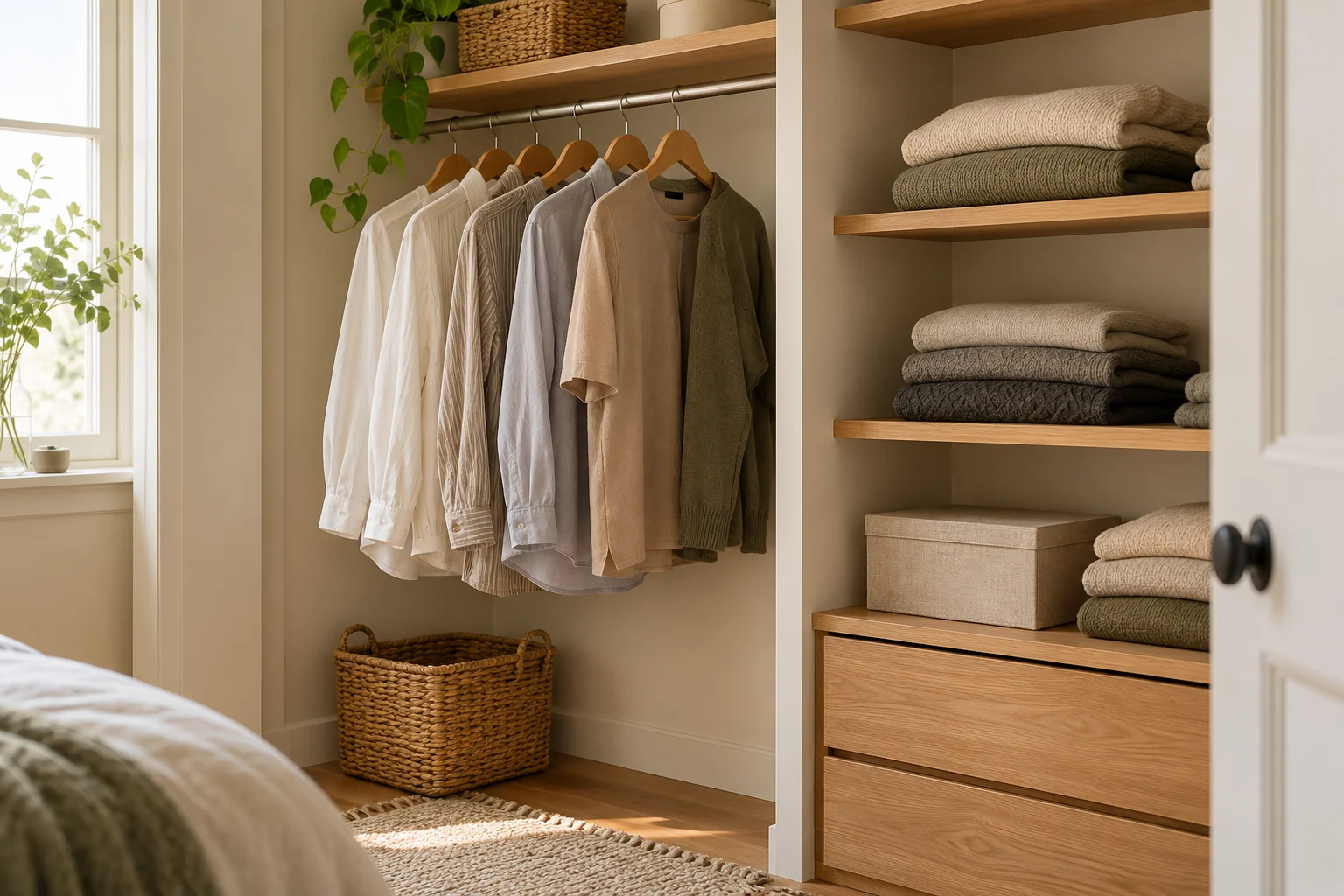
Separate two different measurements
An empty-hanger comparison measures hardware thickness. A loaded-rail comparison includes shirts, sleeves, jackets, and the space needed to handle them. These are not interchangeable claims. Twenty hypothetical 10 mm hangers total 200 mm of material thickness, while twenty 2 mm hangers total 40 mm; that arithmetic does not establish a matching reduction when clothes are added.
Test your actual wardrobe
Choose the same garments and rail section for both arrangements. Keep spacing criteria consistent: you should be able to remove an item without forcing its neighbors aside. Measure the occupied width, record the hanger types, and note whether bulky clothing changes the result. Keep appropriate specialized support for structured pieces. A useful improvement may be easier movement rather than fitting twice as many clothes. Treat any universal doubling claim cautiously unless its method, comparison, and realistic garment sample are clearly disclosed.
Keep the comparison fair
Mark the rail endpoints and photograph the same clothing in both arrangements. Use normal hanging behavior rather than flattening sleeves in one version and leaving them loose in the other. Record whether the rail supports slide comfortably and whether your largest garments remain appropriately supported. If you decide to report a percentage, calculate it from the measured loaded widths and label the result as that specific comparison. Do not substitute the ratio of hanger thicknesses for the ratio of usable closet capacity; they describe different things.
About our editorial approach · Created with AI assistance.