Choose an ordinary item
Deep shelves often hold more than you can comfortably see. To test one, choose a garment stored at the back that you actually wear. Start with the shelf in its normal state. Remove that garment and put the remaining clothes back exactly as you would on a busy morning. Notice what you had to lift, hold, or place on the floor.
The aim is not to prove that deep shelves are bad. It is to decide which categories deserve the easiest part of the shelf and which can tolerate an extra step.
Separate access from storage volume
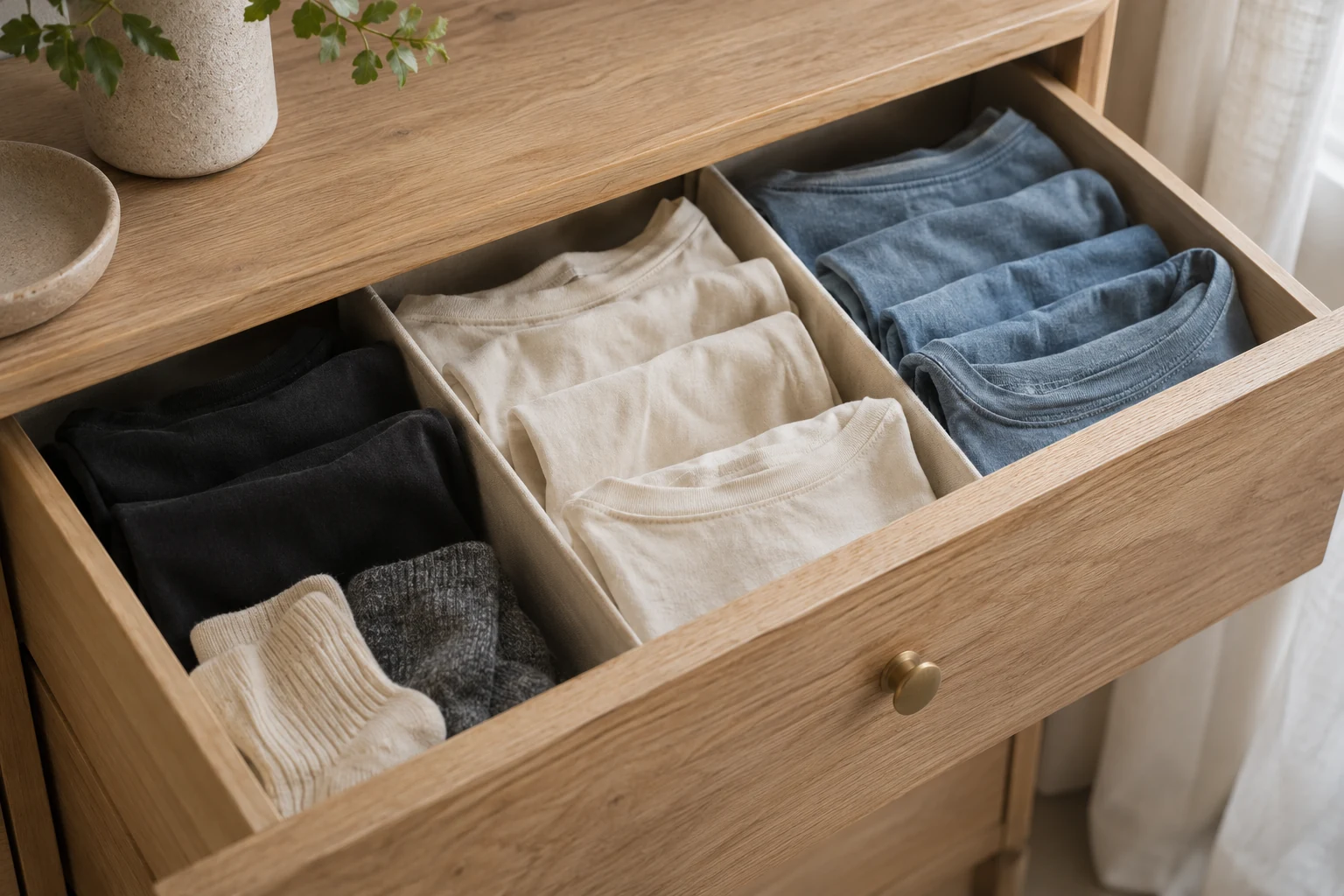
A back row can work for rarely used items if you know what is there and can reach it without destabilizing the front row. It works less well for a favorite shirt that is hidden every time laundry is returned. Try a removable tray or a small container that brings the whole back group forward, provided the shelf and container are suitable for the load.
Keep the container light enough for comfortable handling. Do not turn one difficult garment into a heavy box that is harder to move.
Retest after a simple change
Move the most frequently retrieved group to the front and give the back row one defined role, such as next-season clothing. Add a short label at the shelf edge if the contents cannot be seen. Avoid stacking a second unrelated category above the item you expect to lift out.
Repeat the original test with the same garment. A useful arrangement reduces the number of things you touch and makes returning the item equally easy. If access still feels awkward, leave some depth unused. Usable storage is the space that helps your routine, not every cubic inch inside the cabinet.
About our editorial approach · Created with AI assistance.